
SNGPL Domestic Gas Connection 2026 New Household Connections Full Guide
SNGPL Domestic Gas Connection 2026
SNGPL Domestic Gas Connection 2026 Pakistan is facing a continuous rise in demand for domestic energy, especially natural gas for household use. New housing societies, increasing population, and shifting lifestyle needs have made gas connection one of the most searched public services in the country. Families want a stable, affordable, and long-term cooking fuel solution, and natural gas remains the first choice for most households.
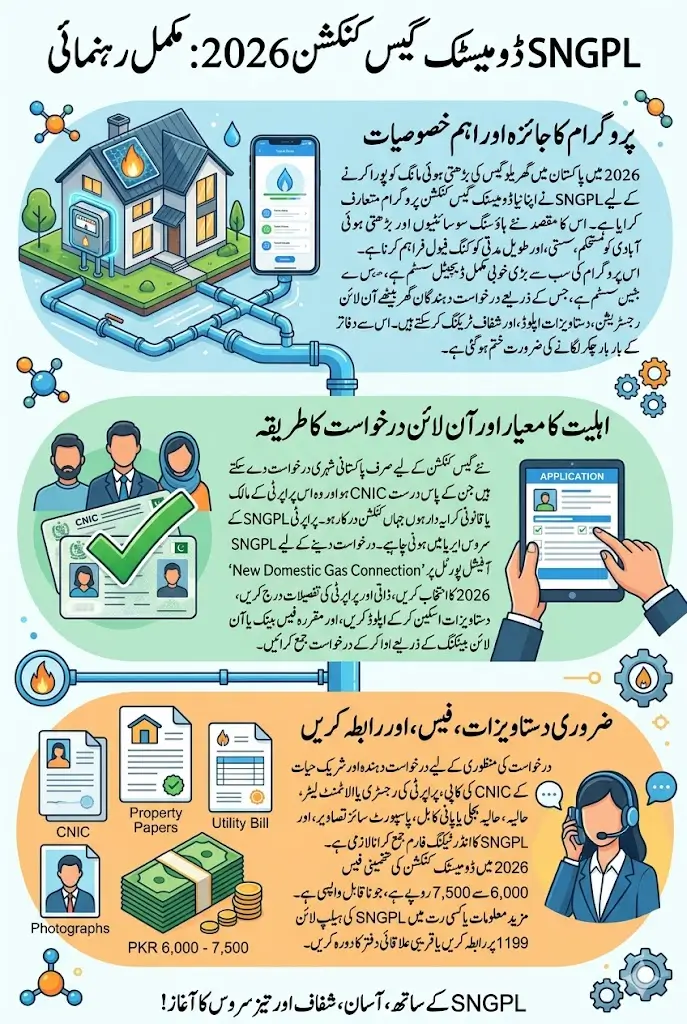
The updated system introduced by Sui Northern Gas Pipelines Limited is designed to make the process easier through digital registration and transparent tracking. Instead of visiting offices again and again, applicants can now apply online, upload documents, and monitor progress from home. This shift is part of Pakistan’s broader move toward digital public service systems.
From what is being observed in 2026, the focus is not only on new connections but also on improving supply management, reducing delays, and expanding pipeline coverage in developing areas. This guide explains the complete process in simple language so every citizen can understand it easily.
You Can Also Read: PM Laptop Scheme Merit List 2026
Overview of New Domestic Gas Connection Program
The SNGPL Domestic Gas Connection 2026 program is built to handle increasing demand for residential gas meters. Many newly built houses in urban and semi-urban areas still do not have gas supply, and this program aims to fill that gap through structured planning and better resource management.
The most important change in this program is the shift toward full digital processing. Earlier, people had to stand in long queues and submit physical forms. Now, everything from application submission to tracking is available online, which reduces human error and corruption risks.
Key Features of 2026 Gas Connection System
- Fully online registration and submission process
- Digital tracking system for application updates
- Faster verification through computerized records
- Reduced need for physical office visits
- Improved transparency in approval stages
- Better coordination between field survey teams and head office
This system is especially helpful for people living in smaller cities and newly developed housing schemes where access to SNGPL offices is limited.
You Can Also Read: Honhaar Scholarship 2026 Registration Open
Who Can Apply for a New Gas Connection
Eligibility is one of the most important parts of the SNGPL gas connection process because not every applicant automatically qualifies. The system is designed to ensure that only genuine residential users receive new connections and resources are used fairly.
In most cases, the applicant must be a Pakistani citizen with a valid CNIC and must own or legally rent the property where the gas connection is requested. The property must also fall within the official service coverage area of SNGPL. If the area is not connected to the pipeline network, the application may be kept pending until expansion reaches that location.
Eligibility Requirements Explained
- Applicant must hold valid Pakistani CNIC
- Property must be residential, not commercial or industrial
- Location must fall under SNGPL jurisdiction area
- No existing or previous gas connection at the same property
- Valid ownership documents or tenancy agreement required
- All outstanding utility dues must be cleared before application
These conditions are strictly followed because gas supply is directly linked to infrastructure capacity, and improper allocation can cause system overload.
You Can Also Read: UAE Visa Ban 2026 Visas Suspended for 9 Countries
Eligibility Criteria
| Requirement | Description |
|---|---|
| Citizenship | Pakistani CNIC holder only |
| Property Type | Residential house or apartment |
| Service Area | Must be under SNGPL network coverage |
| Connection Status | No previous active gas connection |
| Documentation | Ownership or tenancy proof required |
| Utility Clearance | No unpaid bills or dues allowe |
Complete Online Application Process Explained
The application process for SNGPL domestic gas connection has been redesigned in 2026 to make it more user-friendly. Now, instead of manually submitting forms at regional offices, applicants can complete the entire process online through the official portal.
In real experience, users only need a mobile phone or computer with internet access. The system guides applicants step by step, which reduces confusion for first-time users. However, careful data entry is important because mistakes can delay approval significantly.
Step-by-Step Application Method
- Visit official SNGPL online registration portal
- Select “New Domestic Gas Connection 2026” option
- Enter CNIC number and personal details correctly
- Provide complete property address and ownership information
- Upload scanned documents in clear format
- Pay application fee through bank or online banking channels
- Submit application and save tracking ID for future use
Once the application is submitted, applicants can log in again anytime to check status updates. This tracking system is one of the biggest improvements introduced in recent years.
You Can Also Read: Bank Eid Holidays 2026 Reopening Schedule Full Details
Essential Documents Required for Approval
Document verification plays a very important role in the approval process. Many applications are delayed simply because documents are unclear, mismatched, or incomplete. That is why applicants are advised to prepare all required papers before starting the online process.
From field reports and user feedback, it is clear that most issues come from missing property documents or incorrect CNIC details. SNGPL uses these documents to confirm identity and property ownership before moving to the site survey stage.
Required Documents Checklist
- CNIC copy of applicant and spouse
- Property registry, allotment letter, or tenancy agreement
- Latest electricity or water bill for address verification
- Passport-size photographs of applicant
- Undertaking form issued by SNGPL
Submitting clear and updated documents helps speed up verification and reduces the chances of rejection or repeated follow-ups.
You Can Also Read: 8558 Ramzan Package Check Online KPK And Receive Payment
Application Charges and Payment Details
The cost structure for new gas connections in 2026 is designed to cover administrative processing, survey work, and installation costs. The application fee is non-refundable, which means it is not returned even if the application is rejected due to eligibility issues.
Apart from the application fee, some cases may also require a security deposit depending on the size of the connection and gas load requirement. Payment is accepted through banks and online systems to make the process easier and more accessible.
| Category | Estimated Cost |
|---|---|
| Application Fee | PKR 6,000 – 7,500 |
| Security Deposit | Based on gas load requirement |
| Payment Methods | Bank deposit, online transfer |
| Refund Policy | Application fee is non-refundable |
Keeping payment receipts is very important because they are required during verification and future tracking.
Connection Approval and Installation Timeline
After submission, the application does not get approved immediately. It goes through multiple stages including document verification, field inspection, and pipeline availability assessment. Each stage is important to ensure safe and fair distribution of gas supply.
In most cases, the full process takes around 3 to 6 months, but this time can increase depending on infrastructure conditions in the applicant’s area. Areas with active pipeline expansion usually get faster approvals compared to remote or newly developed regions.
The site survey is a critical step where SNGPL officials physically visit the property to check technical feasibility. Without a successful survey, installation cannot proceed even if documents are complete.
You Can Also Read: Aghosh Program Check Balance Online by CNIC Complete
Latest LNG Supply Policy Updates 2026
In 2026, energy authorities have focused on improving LNG supply management and expanding pipeline infrastructure. The main goal is to meet increasing household demand while ensuring fair distribution across regions.
From current developments, it is clear that priority is being given to areas facing energy shortages and newly developed housing schemes. Digital verification has also improved processing speed and reduced manual errors.
Major Policy Updates
- Expansion of pipeline network in urban and rural areas
- Priority supply for energy-deprived regions
- Faster digital verification system for applications
- Improved monitoring of pending applications
- Better coordination between field teams and headquarters
These updates are expected to reduce long waiting times and improve service delivery in the coming years.
Common Problems Applicants Face
Many applicants face repeated challenges during the registration process. These issues are mostly technical or related to documentation errors. In many cases, applicants are unaware of small mistakes that lead to rejection.
One major issue is incomplete documentation, while another is incorrect data entry. Some applicants also face delays due to pipeline unavailability in their area.
Common Issues List
- Application rejection due to incomplete documents
- Incorrect CNIC or property details entered
- Delay caused by pipeline shortage
- Duplicate applications for the same property
- Slow response in remote areas
Understanding these problems helps applicants prepare better before starting the process.
Practical Solutions to Avoid Delays
To make the process smooth, applicants should carefully follow all instructions and double-check their information before submission. Small mistakes can lead to long delays, so attention to detail is very important.
It is also recommended to apply only once per property because multiple applications can create confusion in the system. Keeping tracking information safe is also necessary for future updates.
Helpful Tips for Applicants
- Always verify CNIC and property details before submission
- Upload clear and readable documents
- Apply only once for each property
- Keep tracking ID and receipts safe
- Regularly check application status online
These simple steps can significantly improve approval chances and reduce unnecessary delays.
Important Guidelines for Applicants
Applicants should understand that gas connection approval is not only a form submission process but also depends on infrastructure availability. Even if all documents are correct, final approval depends on pipeline access in the area.
It is also important to use only official SNGPL platforms to avoid misinformation or fraud. Many fake websites mislead applicants, so caution is necessary.
- Apply only through official SNGPL portal
- Ensure property falls within service area
- Do not submit false or incomplete information
- Keep all documents updated and valid
- Follow official instructions carefully
FAQs
Q1: How can I apply for SNGPL gas connection in 2026?
You can apply through the official online portal by submitting CNIC, property details, and required documents.
Q2: What is the total application fee?
The application fee is approximately PKR 6,000 to 7,500 depending on category.
Q3: How long does approval take?
It usually takes 3 to 6 months depending on survey results and pipeline availability.
Q4: What documents are required?
CNIC, property ownership proof, utility bill, photographs, and undertaking form are required.
Q5: Is gas guaranteed after approval?
Gas supply depends on pipeline availability in your area.
Final Thoughts
The SNGPL Domestic Gas Connection 2026 system is a major step toward modernizing public service delivery in Pakistan’s energy sector. With digital registration, faster verification, and improved transparency, the process has become more accessible for ordinary citizens.
However, applicants still need patience because infrastructure limitations and pipeline expansion take time. For households planning to apply, proper documentation and correct information are the key to avoiding delays